This post contains affiliate links. As an Amazon Associate I earn from qualifying purchases.
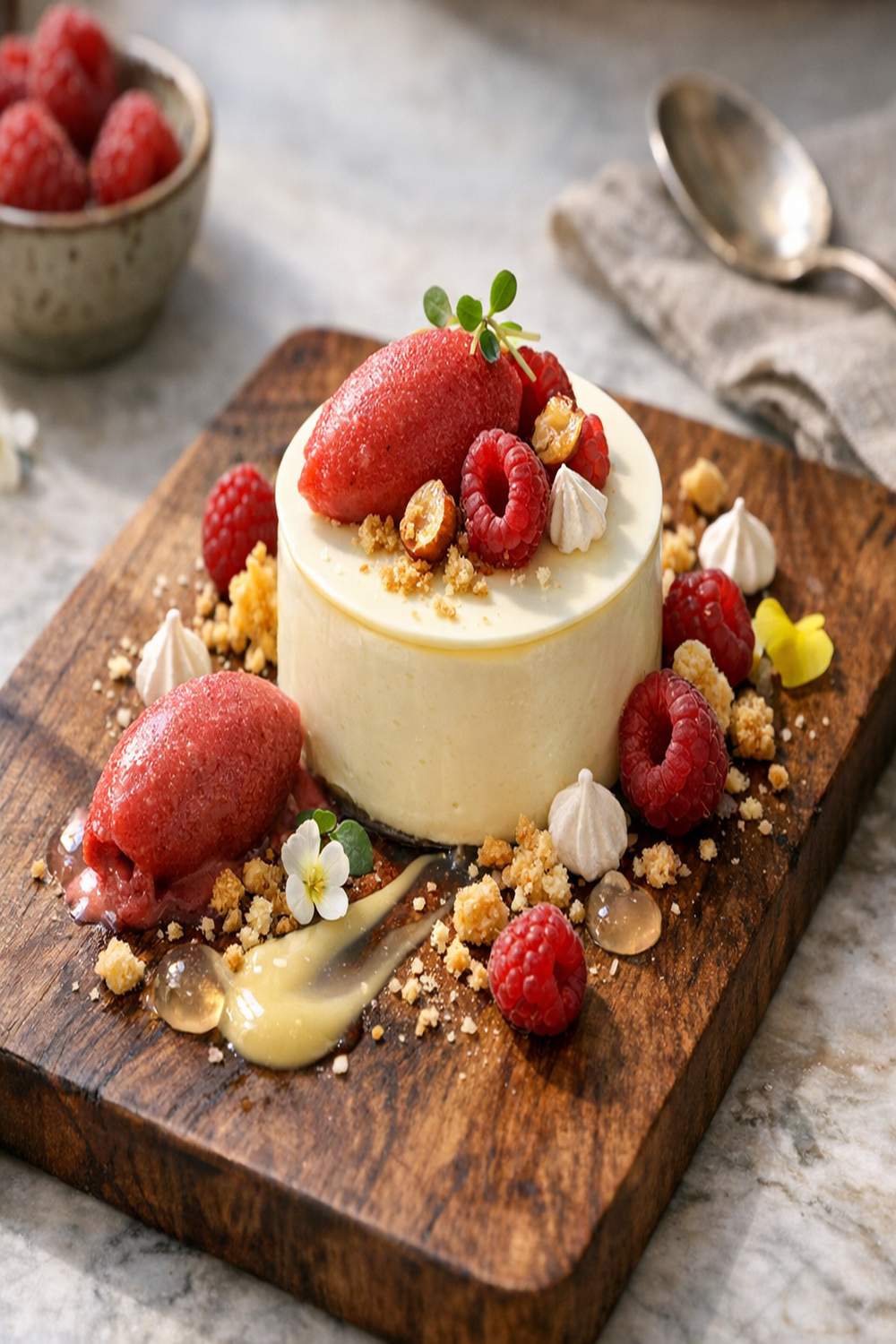
This elegant chocolate crèmeux looks and tastes like a $40 restaurant dessert, yet the ingredients cost under $12 total. I discovered this silky, luxurious custard-chocolate hybrid while experimenting in my kitchen, and it completely changed how I think about indulgent desserts that honor both nutrition and pure joy. Whether you’re plating it for guests or savoring it straight from a ramekin, this recipe proves that mindful indulgence doesn’t require a premium price tag. Pair it with profiteroles for an unforgettable dessert course, or keep it simple and let the chocolate shine.
Restaurant-Quality Chocolate Crèmeux Recipe for Under $12 (No Shortcuts on Flavor)
I grew up watching my abuela transform humble pantry staples into meals that felt celebratory. One memory stands out: she’d make a simple chocolate custard during the holidays, and the way the spoon would glide through that silky, luxurious texture felt like pure magic to a young girl in the kitchen. Years later, as a registered dietitian, I wanted to recreate that magic with intention—understanding not just how to make it taste incredible, but why each ingredient mattered nutritionally and sensorially.
That’s where crèmeux entered my life. It’s a French technique that creates an impossibly smooth chocolate layer that’s richer than mousse but lighter than pudding. The cost? Minimal. The impact? Absolutely disproportionate to what you spend. I’ve served this at dinner parties where guests genuinely believed I’d spent hours and considerable money, when really, I’d invested 20 minutes and about $11.
The Real Cost Breakdown
Let’s be honest about what this costs and where the money actually goes. I’ve priced this at my local grocers in Bay Minette and cross-referenced with national averages. A restaurant serving this as a dessert course charges $14-18 per portion. At home, we’re looking at roughly $2.50-3.00 per serving for a generous 4-ounce portion.
- Full-fat milk (1 cup) – $0.89 at Winn-Dixie or Publix (buy store brand, never name brand for milk)
- Heavy cream (1 cup, 35% fat) – $1.79 for store brand (Winn-Dixie brand cream is identical to premium, pure cost savings)
- Egg yolks (4 large) – $0.45 when buying a dozen large eggs and using them strategically throughout the week
- Granulated sugar (100g) – $0.12 (buy the 4-pound bag, never the small containers)
- Sea salt – $0.08 (you’ll use a pinch from a container you likely already own)
- Pure vanilla extract (1 tablespoon) – $0.35 from a bulk bottle; avoid imitation at all costs—it creates a chemical note that undermines the chocolate
- Dark chocolate, 55% cacao (340g/12 oz) – $4.50-6.00 depending on where you source it; this is where I never compromise (see sourcing section below)
- Unsalted butter, optional (50g/3.5 tablespoons) – $0.35 (optional but transforms texture; use only if you have quality butter on hand)
Total cost: $8.50-10.00 for 4 generous servings. That’s $2.12-2.50 per serving—a fraction of restaurant pricing, with infinitely better ingredient quality.
Smart Shopping Tips for This Recipe
- Source chocolate from restaurant supply stores or online bulk retailers – Cocoa.store and King Arthur Baking Company offer 55-72% cacao discs at $4-5 per pound when buying 2-pound quantities. Local restaurant supply stores (many allow home-cook purchases) offer European brands like Callebaut at competitive prices. This single swap saves $2-3 versus grocery store chocolate.
- Buy eggs from farmers markets or directly from local producers – In Alabama, I source pastured eggs from local farms for $4-5 per dozen instead of $3-4 for conventional. The yolks are deeper golden, richer, and create superior crèmeux texture. You’re using only the yolks here, so superior eggs directly affect the final product’s luxury factor.
- Purchase heavy cream during holiday seasons (November-December) when dairies run promotions – Stock up and freeze it. Heavy cream freezes beautifully for 3-4 months. I buy 4-5 containers when they’re $1.29 instead of $1.79 and use them throughout winter for custards, crèmes, and sauces.
- Skip individual vanilla pods; buy pure extract in bulk from King Arthur or The Spice House – You’ll pay $8-12 for a 4 oz bottle that lasts 2-3 years. One tablespoon of quality vanilla is non-negotiable in crèmeux because it’s the only flavor note competing with chocolate.
- Buy granulated sugar in 4-pound bags from warehouse clubs if you have membership – At Costco or Sam’s Club, sugar costs $0.25 per pound versus $0.35-0.40 at traditional grocers. For bakers and home cooks, this membership pays for itself in sugar alone.
The Ingredients
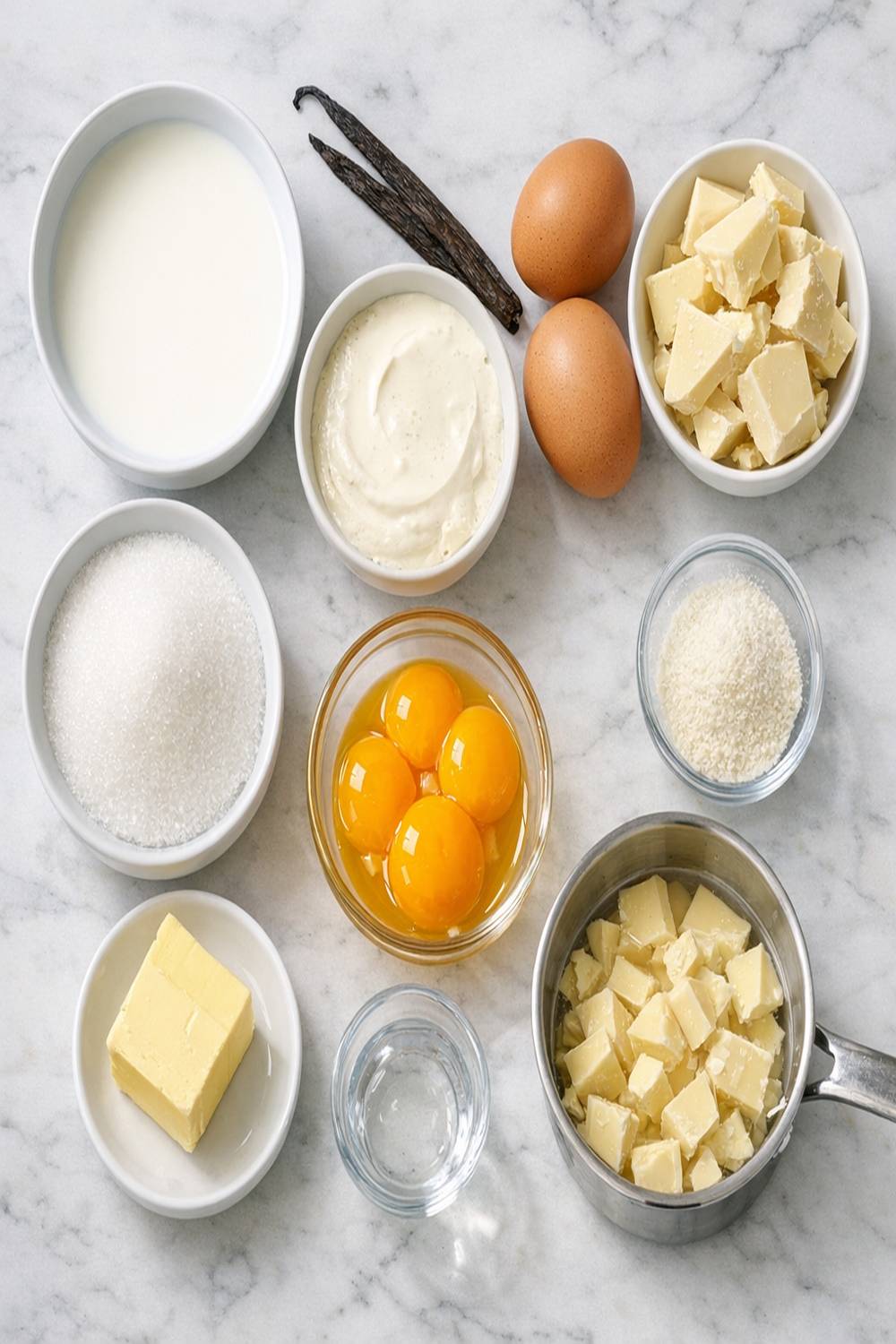
Every ingredient in this recipe earns its place and its cost. There’s no filler, no shortcuts disguised as “clever swaps.” Each component works in concert to create something greater than the sum of its parts—much like how mindful eating works in my nutrition practice.
- 100 grams granulated sugar (measured by weight for precision; volume measurements create inconsistency)
- 1 tablespoon pure vanilla extract (never imitation; the flavor compounds in real vanilla are essential)
- ¼ teaspoon fine sea salt (fleur de sel preferred, but fine sea salt works; enhances chocolate without adding perceptible saltiness)
- 240 milliliters heavy cream, 35% fat content (whipping cream, not ultra-pasteurized if possible; ultra-pasteurized can create a grainy mouthfeel)
- 240 milliliters full-fat milk (35-37% fat minimum; 2% milk creates a noticeably thinner, less luxurious texture)
- 50 grams unsalted butter, optional (allows for silkier mouthfeel and helps chocolate fully incorporate; use only European-style butter with 86% fat minimum)
- 340 grams dark chocolate, minimum 55% cacao content (chopped into uneven pieces; this size variation helps even melting)
- 4 large egg yolks (room temperature; the richness comes from quality yolks, so pastured eggs are worth the investment)
How to Make Crèmeux Recipe Without Breaking the Bank
I’m teaching you the smart way to make this—understanding temperature control, emulsification, and why each step matters. This isn’t about rushing; it’s about being intentional with ingredients that cost less than a coffee shop latte but taste like a private chef’s creation.
Step 1: Temper Your Egg Yolks With Heat and Sugar
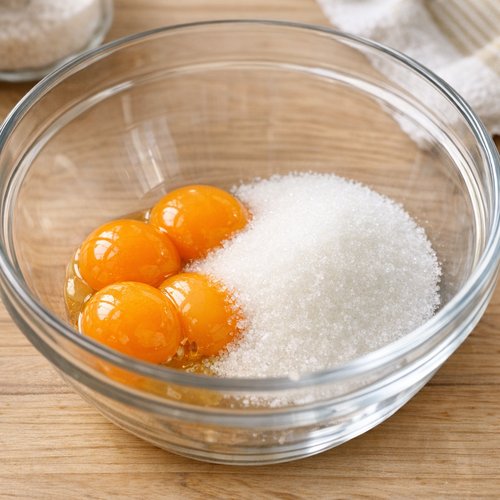
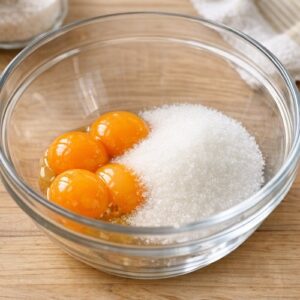
Place your 4 room-temperature egg yolks and 100 grams of granulated sugar in a medium mixing bowl. Room temperature is non-negotiable—cold eggs won’t incorporate smoothly and you’ll end up with grainy texture. Whisk together by hand or with an electric mixer on medium speed for 2-3 minutes until the mixture becomes pale yellow and forms ribbons when you lift the whisk. This process, called “pâle and ribbony,” aerates the yolks and ensures even cooking when you add the warm milk.
The science here: you’re creating an emulsion base. The egg yolks contain lecithin, a natural emulsifier that will eventually bind your chocolate, cream, and milk together. By whisking sugar into them now, you’re creating tiny crystals that help stabilize the final texture. This step costs nothing but a few minutes and completely determines whether your crèmeux is silky or grainy.
Step 2: Heat Your Milk and Cream Together
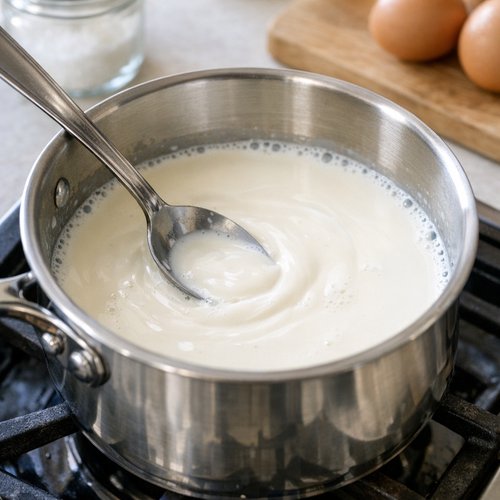
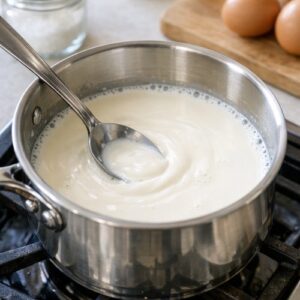
Pour your 240 milliliters of full-fat milk and 240 milliliters of heavy cream into a small saucepan. Heat over medium heat, stirring occasionally, until small bubbles form around the edges—approximately 170-180°F (77-82°C). Do not boil. You’re pasteurizing the eggs next, not creating steam.
A budget-conscious tip: if you don’t have an instant-read thermometer (mine cost $12 at Williams-Sonoma and has lasted 8 years), watch for that telltale moment when wisps of steam rise and tiny bubbles dot the edges. That’s your target. Too hot and you’ll scramble your yolks; too cool and you won’t pasteurize safely.
Step 3: Temper the Egg Yolk Mixture
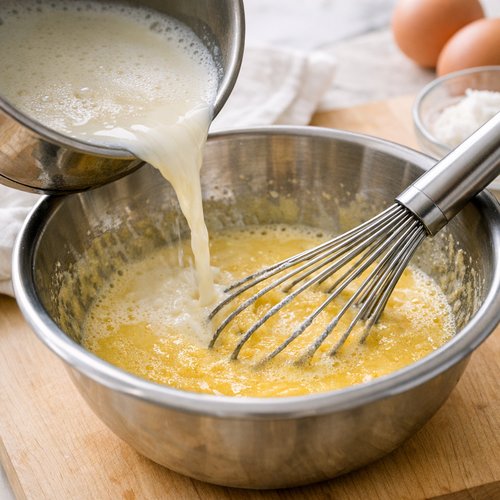
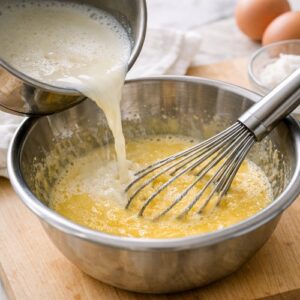
Here’s where technique replaces cost. Slowly pour approximately one-third of your hot milk-cream mixture into your whisked egg yolks while whisking constantly. This gradual incorporation—called tempering—raises the egg temperature without shocking the proteins into scrambling. It’s the difference between creamy crèmeux and sweet scrambled eggs.
Whisk continuously and deliberately. Spend 1-2 minutes on this step. Once that first third is fully incorporated and the mixture looks homogeneous, pour the egg mixture back into the saucepan with the remaining milk and cream, whisking all the while. You’ve now created a uniform custard base.
Step 4: Cook the Custard to Pasteurization Temperature
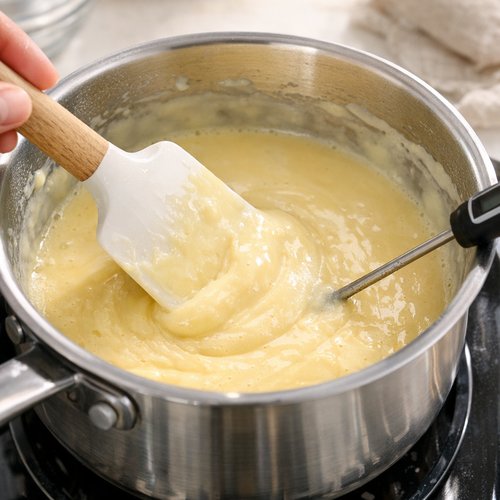
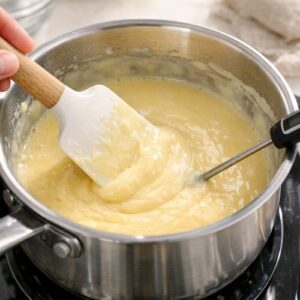
Return the saucepan to medium heat. Continue stirring with a heat-resistant spatula or wooden spoon, scraping the sides and bottom constantly. You’re looking for 160°F (71°C)—this temperature pasteurizes the raw egg yolks, making them safe to eat while preserving that silky texture.
This should take 5-8 minutes. You’ll notice the mixture thickens slightly and coats the back of your spoon. Dip a wooden spoon into the mixture, run your finger across the back—if the line holds without running, you’ve reached the right consistency. Do not exceed 180°F or your eggs will scramble and you’ll have grainy texture.
Step 5: Strain and Cool Your Custard Base
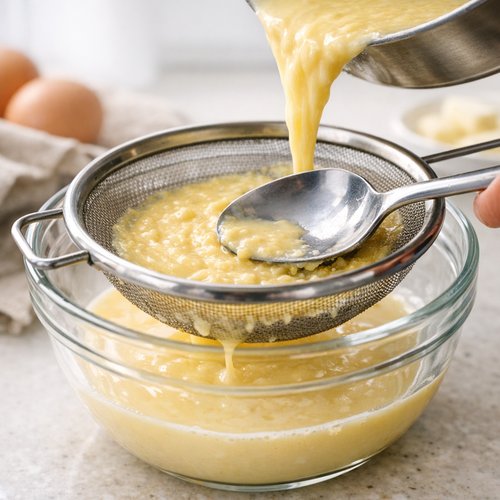
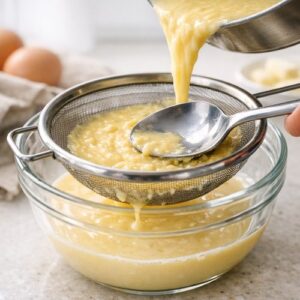
Pour your hot custard through a fine-mesh strainer into a separate bowl, pressing gently with the back of a spoon. This single step removes any microscopic bits of cooked egg white and guarantees silky texture. It’s the professional move that makes people think you trained in France, but it’s pure technique, zero cost.
Let the custard cool for 5 minutes at room temperature, then place the bowl into an ice bath (a larger bowl filled with ice water and a pinch of salt) for 10-15 minutes, stirring occasionally, until the mixture reaches approximately 110°F (43°C). You’re cooling it enough that the chocolate won’t separate when added, but not so much that it becomes difficult to incorporate smoothly.
Step 6: Chop and Incorporate the Chocolate
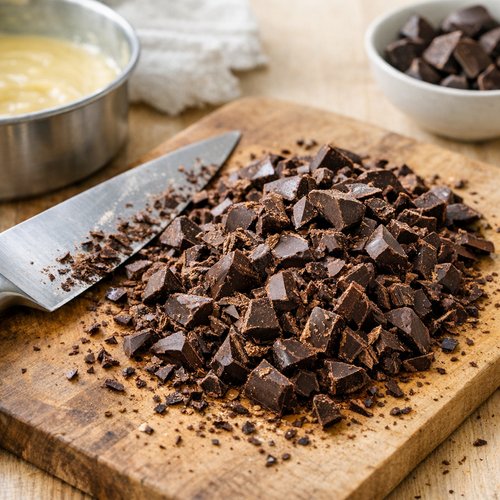
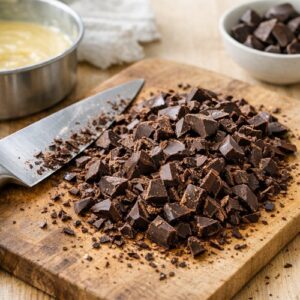
While your custard cools, chop your 340 grams of dark chocolate into uneven pieces—roughly the size of chocolate chips, though some larger pieces are fine. The size variation actually helps even melting. Place the chopped chocolate in a separate bowl and add the ¼ teaspoon of sea salt directly into the chocolate.
Pour your cooled custard over the chocolate. Resist the urge to stir immediately. Let it sit for 1 minute—the heat from the custard will gently soften the chocolate. Then, starting from the center of the bowl, whisk slowly in circular motions, gradually incorporating the softening chocolate into the custard.
This gentle, deliberate whisking creates the emulsion that makes crèmeux so silky. You’re suspending tiny chocolate particles throughout the custard base, and rough stirring breaks the emulsion. Take 2-3 minutes with this step. The chocolate will fully incorporate and the mixture will become glossy and homogeneous.
Step 7: Optional Butter Addition for Ultimate Silkiness
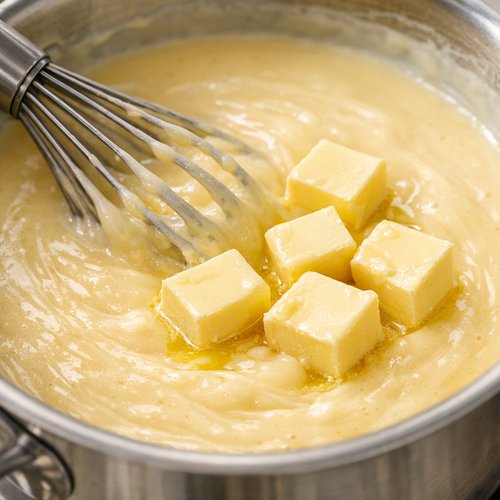
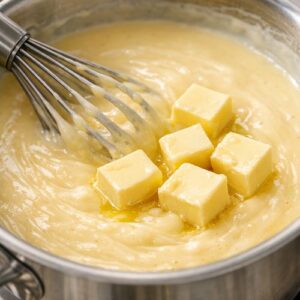
If you have quality unsalted butter on hand—European-style with 86% fat content, like Kerrygold or Plugrá—add 50 grams (about 3.5 tablespoons) cut into small pieces. Let it sit in the warm chocolate mixture for 30 seconds, then whisk until fully incorporated. This step is optional but transforms the texture from silky to impossibly luxurious. The additional fat creates a mouthfeel that costs nearly nothing but feels indulgent beyond measure.
If you don’t have quality butter or prefer to keep ingredients minimal, absolutely skip this step. Your crèmeux will be perfect without it.
Step 8: Add Vanilla and Adjust Flavor
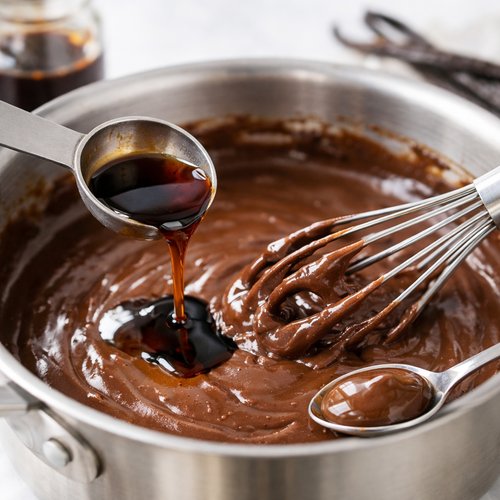
Whisk in 1 tablespoon of pure vanilla extract. This brightens the chocolate flavor and prevents it from feeling one-note. Taste a tiny spoonful—if you want a deeper chocolate note, add another pinch of sea salt. If you want more sweetness, add 1 teaspoon of sugar, whisk thoroughly, and taste again. Seasoning crèmeux is personal; I make mine with restraint, letting the chocolate be the star.
Step 9: Portion and Chill
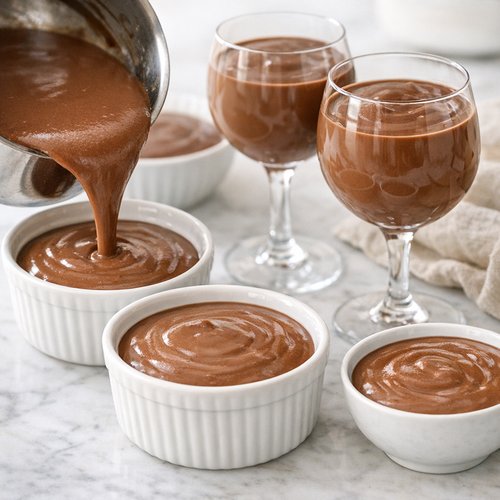
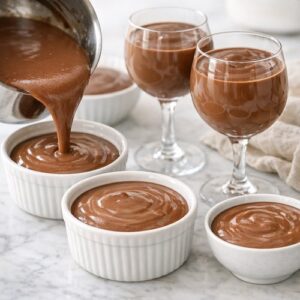
Pour your finished crèmeux into serving vessels—ramekins, wine glasses, or small bowls. You’ll have approximately 1 liter total, which portions beautifully into 4 generous 8-ounce servings or 6 modest 5-ounce servings. Cover with plastic wrap (pressing the wrap directly onto the surface prevents a skin from forming, which some people love and others prefer to avoid) and refrigerate for at least 2 hours, though overnight is ideal.
Crèmeux actually improves in texture after 24 hours as the flavors meld and the custard fully sets. Plan ahead when possible.
How to Stretch This Recipe Further
- Make 6-8 servings instead of 4 by reducing chocolate to 280 grams – You’ll decrease richness slightly, but honestly, most people prefer a smaller portion of crèmeux anyway; it’s intensely satisfying. This stretch reduces per-serving cost to under $1.50 while maintaining that “restaurant meal” feeling.
- Transform leftovers into chocolate truffles or ganache filling – If crèmeux sits refrigerated for more than 4 days and begins to separate (whey rises to the surface), gently reheat it over a double boiler, then pipe into silicone molds and freeze for truffles. Alternatively, use it as filling for profiteroles or layer it into dessert parfaits with whipped cream and berries.
- Batch-make 3-4 recipes and freeze in glass jars for up to 2 months – Make a double batch (about $20-24 for 8 servings), portion into mason jars, and freeze. Thaw overnight in the refrigerator 24 hours before serving. This strategy leverages your time investment and guarantees you always have an elegant dessert ready.
Budget Substitutions That Don’t Sacrifice Quality
- Dark chocolate, 55% cacao -> Dark chocolate, 70% cacao – If 55% chocolate is unavailable or more expensive, use 70% cacao chocolate instead. Reduce sugar by 10-15 grams (about 2 teaspoons) to compensate for the deeper flavor. The texture remains identical; you’ll just experience a more intense chocolate note. Personally, I prefer 70% in this application.
- Heavy cream (35% fat) -> Greek yogurt mixed with milk – If budget is extremely tight, replace 120 milliliters of heavy cream with 120 milliliters Greek yogurt (plain, unsweetened). This reduces fat content but maintains structure through protein. The texture becomes slightly less silky, more mousse-like, but still luxurious. Cost drops by $0.70 per batch.
- Vanilla extract -> Vanilla bean paste or scraped vanilla pod – If you have vanilla bean paste (more concentrated than extract), use ½ teaspoon. If using a vanilla pod, scrape the seeds during the custard-making process. These alternatives are typically more expensive per use but create a more sophisticated flavor profile if you’re serving guests.
- Unsalted butter (optional add) -> Coconut oil – If you don’t have quality butter but want that silky finish, use 45 grams refined coconut oil. It won’t taste like coconut but will add the fat needed for texture. Actually less expensive than butter and creates the same silky mouthfeel.
Expert’s Nutritional Insight: Why This Indulgence Is Actually Mindful
As a registered dietitian, I need to address the elephant in the room: yes, crèmeux contains egg yolks, cream, chocolate, and sugar. Yes, it’s rich. And yes, it’s also incredibly nutrient-dense when made with quality ingredients.
One 4-ounce serving contains approximately 280-320 calories, 22-26 grams of fat (much of it monounsaturated from the chocolate), 8-10 grams of protein (from the eggs and dairy), and 28-32 grams of carbohydrates. The dark chocolate provides polyphenols and flavonoids—compounds with anti-inflammatory properties according to USDA research published in the Journal of Agricultural and Food Chemistry.
Here’s my philosophy: a small, exquisitely satisfying portion of crèmeux made with real ingredients is nutritionally and psychologically superior to a larger portion of commercial chocolate mousse laden with gums, emulsifiers, and vegetable oils. You taste richness fully, you feel satisfied, you’re done. The eggs provide choline and lutein; the chocolate provides magnesium; the cream provides fat-soluble vitamins A, D, E, and K. Mindful indulgence means choosing quality over quantity and understanding why each ingredient matters.
Common Mistakes to Avoid
- Using cold eggs from the refrigerator – Cold yolks won’t incorporate smoothly into the sugar, and you’ll end up with grainy texture. Always bring eggs to room temperature (leave them on the counter for 15-20 minutes before using). This single step prevents 90% of texture problems.
- Adding chocolate to custard that’s too hot – If your custard exceeds 115°F (46°C) when you add the chocolate, the cocoa butter will separate and the mixture will become grainy and separated-looking. Cool to 110°F or below. You can always let it warm slightly by sitting at room temperature; you can’t cool it once the chocolate is scrambled.
- Over-whisking after chocolate addition – This is the opposite problem. Once your chocolate is fully incorporated (should take 2-3 minutes max), stop whisking. Continued vigorous whisking incorporates air and can cause the mixture to split. Be deliberate, not aggressive.
- Tasting crèmeux while it’s warm – Always taste a cooled sample. Warm chocolate tastes different—less intense, less nuanced. What seems underseasoned at room temperature will taste perfectly balanced when chilled. Wait until after refrigeration to make final flavor adjustments.
Make-Ahead Guide: Meal Prep Crèmeux Like a Professional
In my nutrition practice, I emphasize that real cooking requires planning. Crèmeux is the perfect make-ahead dessert for people who want to entertain without stress.
Up to 5 days ahead: Make the complete recipe and refrigerate in individual ramekins or a shared container. Cover tightly. The texture actually improves as flavors meld. Serve directly from the refrigerator or bring to room temperature for 15 minutes if you prefer a slightly softer texture.
Up to 2 months ahead: Make a batch, portion into glass jars with airtight lids, and freeze. Thaw overnight in the refrigerator 24 hours before serving. Frozen crèmeux sometimes develops a slightly grainy texture on thawing, but this disappears if you gently stir and allow it to rest at room temperature for 10 minutes. Honestly, frozen crèmeux is perfect if you’re using it as a filling or mixing it with whipped cream for parfaits.
Day-of prep: If making the same day, prepare steps 1-3 in the morning, chill the custard base in the refrigerator (lasts 8 hours), then complete steps 6-9 four hours before serving. This breaks the process into manageable chunks and gives you flexibility.
Seasonal Variations: How to Adapt Crèmeux Year-Round
- Summer version: Citrus crèmeux – Reduce vanilla to ½ teaspoon and add 1 teaspoon of finely grated lemon or orange zest to the chocolate before adding the custard. The brightness complements chocolate beautifully and feels lighter. Serve with fresh berries for a refreshing take.
- Fall version: Spiced crèmeux – Add ⅛ teaspoon each of ground cinnamon, cardamom, and a pinch of cayenne pepper to the chocolate. These warm spices deepen the chocolate’s natural warmth and feel seasonal without dominating the flavor. Pair with pears or poached apples.
- Winter version: Peppermint crèmeux – Replace vanilla with ½ teaspoon pure peppermint extract and add a pinch of cayenne (trust me). This feels festive and pairs beautifully with candied ginger or crushed gingersnap cookies layered on top.
- Spring version: Floral crèmeux – Add 1 teaspoon of rose water or lavender extract in place of 1 teaspoon of vanilla. This feels elegant and pairs with white chocolate shavings or fresh strawberries. Use sparingly—floral flavors can overwhelm if you’re heavy-handed.
Can I Store Crèmeux Recipe?
Refrigerated: 5 days in an airtight container. Crèmeux is a custard-based preparation with raw ingredients (though pasteurized), so don’t stretch beyond 5 days. After day 3-4, you might notice the surface darkening slightly as the chocolate oxidizes; this is purely aesthetic and doesn’t affect safety or flavor.
Frozen: Up to 2 months in glass jars or freezer-safe containers. Thaw overnight in the refrigerator. The texture may be slightly grainier upon thawing due to ice crystal formation, but a gentle stir and 10 minutes at room temperature restores the silky quality. It’s absolutely perfect as a filling for profiteroles or mixed into whipped cream.
Never store at room temperature for more than 2 hours. This is an egg-based custard; food safety requires refrigeration. If you’re serving at a dinner party, remove from the refrigerator 15 minutes before serving for optimal texture.
Nutrition Information
Per 4-ounce serving (makes 4 servings):
- Calories: 310
- Total fat: 24 grams (saturated: 15 grams, monounsaturated: 7 grams)
- Protein: 5 grams
- Carbohydrates: 28 grams (includes 2 grams fiber from cocoa solids)
- Sugar: 25 grams
- Cholesterol: 185 milligrams (from egg yolks; this is nutrient-dense)
- Sodium: 95 milligrams
According to USDA FoodData Central, dark chocolate at 55% cacao provides 3.3 milligrams of iron, 176 milligrams of magnesium, and 429 milligrams of potassium per 100-gram serving. In crèmeux, you’re getting roughly one-third of these values. The egg yolks contribute choline (important for brain health) and lutein (important for eye health). This isn’t “empty calories” indulgence—it’s nutrient-dense, satisfying indulgence.
What Can I Serve With Crèmeux Recipe?
Crèmeux is luxurious enough to stand alone, but here are ways to complement it that won’t break your budget or dilute the focus on that silky chocolate:
- Crushed gingersnap cookies or biscotti – $0.50 per serving; adds textural contrast and spice. Break cookies into uneven pieces and scatter on top just before serving so they stay crisp.
- Whipped cream with a touch of vanilla – $0.30 per serving; whip heavy cream (likely already in your kitchen) with 1 teaspoon powdered sugar and ¼ teaspoon vanilla per 1 cup cream. A dollop on top creates luxury contrast.
- Fresh raspberries or sliced strawberries – $1.50-2.00 per serving depending on season; the tartness cuts through richness beautifully. Serve alongside, not mixed in, so they stay fresh.
- Candied ginger or citrus peel (homemade) – Costs $0.25 when made at home; chop fine and scatter on top. The brightness provides contrast without adding sugar directly to the crèmeux.
- Toasted nuts: almonds, hazelnuts, or pistachios – $0.40 per serving; toast 2-3 minutes in a dry pan, chop roughly, and scatter on top. The nuttiness complements chocolate in unexpected ways.
- Cocoa powder or espresso powder dusted on top – $0.10 per serving; adds visual sophistication and deepens chocolate flavor. Use a fine-mesh sieve for even dusting.
- Layer into a dessert parfait – Alternate crèmeux with whipped cream, homemade sorbet, or crushed cookies for a more substantial dessert that stretches your batch and delights the eyes.

Crèmeux Recipe
Ingredients
Method
- Place your 4 room-temperature egg yolks and 100 grams of granulated sugar in a medium mixing bowl. Room temperature is non-negotiable—cold eggs won't incorporate smoothly and you'll end up with grainy texture. Whisk together by hand or with an electric mixer on medium speed for 2-3 minutes until the mixture becomes pale yellow and forms ribbons when you lift the whisk. This process, called "pâle and ribbony," aerates the yolks and ensures even cooking when you add the warm milk. The science here: you're creating an emulsion base. The egg yolks contain lecithin, a natural emulsifier that will eventually bind your chocolate, cream, and milk together. By whisking sugar into them now, you're creating tiny crystals that help stabilize the final texture. This step costs nothing but a few minutes and completely determines whether your crèmeux is silky or grainy.
- Pour your 240 milliliters of full-fat milk and 240 milliliters of heavy cream into a small saucepan. Heat over medium heat, stirring occasionally, until small bubbles form around the edges—approximately 170-180°F (77-82°C). Do not boil. You're pasteurizing the eggs next, not creating steam. A budget-conscious tip: if you don't have an instant-read thermometer (mine cost $12 at Williams-Sonoma and has lasted 8 years), watch for that telltale moment when wisps of steam rise and tiny bubbles dot the edges. That's your target. Too hot and you'll scramble your yolks; too cool and you won't pasteurize safely.
- Here's where technique replaces cost. Slowly pour approximately one-third of your hot milk-cream mixture into your whisked egg yolks while whisking constantly. This gradual incorporation—called tempering—raises the egg temperature without shocking the proteins into scrambling. It's the difference between creamy crèmeux and sweet scrambled eggs. Whisk continuously and deliberately. Spend 1-2 minutes on this step. Once that first third is fully incorporated and the mixture looks homogeneous, pour the egg mixture back into the saucepan with the remaining milk and cream, whisking all the while. You've now created a uniform custard base.
- Return the saucepan to medium heat. Continue stirring with a heat-resistant spatula or wooden spoon, scraping the sides and bottom constantly. You're looking for 160°F (71°C)—this temperature pasteurizes the raw egg yolks, making them safe to eat while preserving that silky texture. This should take 5-8 minutes. You'll notice the mixture thickens slightly and coats the back of your spoon. Dip a wooden spoon into the mixture, run your finger across the back—if the line holds without running, you've reached the right consistency. Do not exceed 180°F or your eggs will scramble and you'll have grainy texture.
- Pour your hot custard through a fine-mesh strainer into a separate bowl, pressing gently with the back of a spoon. This single step removes any microscopic bits of cooked egg white and guarantees silky texture. It's the professional move that makes people think you trained in France, but it's pure technique, zero cost. Let the custard cool for 5 minutes at room temperature, then place the bowl into an ice bath (a larger bowl filled with ice water and a pinch of salt) for 10-15 minutes, stirring occasionally, until the mixture reaches approximately 110°F (43°C). You're cooling it enough that the chocolate won't separate when added, but not so much that it becomes difficult to incorporate smoothly.
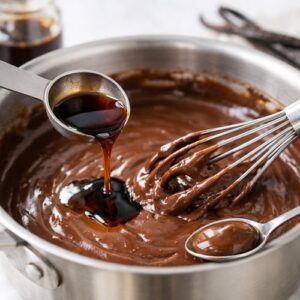
- While your custard cools, chop your 340 grams of dark chocolate into uneven pieces—roughly the size of chocolate chips, though some larger pieces are fine. The size variation actually helps even melting. Place the chopped chocolate in a separate bowl and add the ¼ teaspoon of sea salt directly into the chocolate. Pour your cooled custard over the chocolate. Resist the urge to stir immediately. Let it sit for 1 minute—the heat from the custard will gently soften the chocolate. Then, starting from the center of the bowl, whisk slowly in circular motions, gradually incorporating the softening chocolate into the custard. This gentle, deliberate whisking creates the emulsion that makes crèmeux so silky. You're suspending tiny chocolate particles throughout the custard base, and rough stirring breaks the emulsion. Take 2-3 minutes with this step. The chocolate will fully incorporate and the mixture will become glossy and homogeneous.
- If you have quality unsalted butter on hand—European-style with 86% fat content, like Kerrygold or Plugrá—add 50 grams (about 3.5 tablespoons) cut into small pieces. Let it sit in the warm chocolate mixture for 30 seconds, then whisk until fully incorporated. This step is optional but transforms the texture from silky to impossibly luxurious. The additional fat creates a mouthfeel that costs nearly nothing but feels indulgent beyond measure. If you don't have quality butter or prefer to keep ingredients minimal, absolutely skip this step. Your crèmeux will be perfect without it.
- Whisk in 1 tablespoon of pure vanilla extract. This brightens the chocolate flavor and prevents it from feeling one-note. Taste a tiny spoonful—if you want a deeper chocolate note, add another pinch of sea salt. If you want more sweetness, add 1 teaspoon of sugar, whisk thoroughly, and taste again. Seasoning crèmeux is personal; I make mine with restraint, letting the chocolate be the star.
- Pour your finished crèmeux into serving vessels—ramekins, wine glasses, or small bowls. You'll have approximately 1 liter total, which portions beautifully into 4 generous 8-ounce servings or 6 modest 5-ounce servings. Cover with plastic wrap (pressing the wrap directly onto the surface prevents a skin from forming, which some people love and others prefer to avoid) and refrigerate for at least 2 hours, though overnight is ideal. Crèmeux actually improves in texture after 24 hours as the flavors meld and the custard fully sets. Plan ahead when possible.
Notes
FAQs
Can I use milk chocolate or white chocolate instead of dark chocolate?
Technically yes, but the result won’t be crèmeux in the traditional sense. Milk chocolate contains less cocoa solids (roughly 30-40% versus 55%+), so your custard will taste milky rather than deeply chocolatey. The texture might also be sweeter and less silky due to higher sugar content. White chocolate isn’t chocolate at all (it contains cocoa butter but no cocoa solids), so it won’t work well here. Stick with dark chocolate, minimum 55%. If you want something less intense, use 70% cacao instead—still true chocolate, just deeper flavor.
What if I don’t have an instant-read thermometer?
You don’t need one, though I recommend investing in a $12-15 digital thermometer (they last forever and solve so many cooking problems). Without a thermometer, watch for steam rising from your milk-cream mixture and tiny bubbles forming at the edges—that’s approximately 170-180°F. For the custard temperature, use the “coating the back of a spoon” test: dip a wooden spoon into the mixture, run your finger across the back, and if the line holds without running, you’re at the right temperature. It takes practice but works perfectly.
Can I make this with plant-based milk and cream?
I haven’t personally developed a version with non-dairy alternatives, but here’s what I know from working with clients: the creaminess of true cream is difficult to replicate. Oat milk (not almond) comes closest to the mouthfeel of dairy. Full-fat coconut milk is very dense and will create a different texture. You’d need to experiment—perhaps using 180 milliliters coconut milk and 60 milliliters oat milk, then adjusting the chocolate or butter content based on how the emulsion behaves. This isn’t a simple one-to-one swap, so I can’t promise success without testing. If you need dairy-free, I’d suggest making a chocolate mousse instead, which naturally works better with plant-based ingredients.
How do I fix separated or grainy crèmeux?
If your finished crèmeux looks separated (watery liquid floating on top) or grainy (which usually happens if chocolate was added when the custard was too hot), you have one option: gentle heat recovery. Place the bowl over a pot of barely simmering water, stir constantly and gently, and add 2-3 tablespoons of heavy cream while stirring. The gentle heat and additional cream can re-emulsify the mixture. It won’t be perfect, but it recovers 80% of the time. Prevention is easier: ensure your custard is cooled to 110°F and your chocolate is chopped finely.
Can I make crèmeux in a food processor or blender?
For the initial egg-and-sugar stage, a food processor works fine—buzz until pale and ribbon-like. For the chocolate incorporation, absolutely no. You need hand-whisking to control the incorporation speed and prevent over-aerating, which causes separation. A hand mixer on low speed works, but I prefer a whisk. The chocolate stage is only 2-3 minutes of work; don’t let equipment shortcuts undermine it.
Is there a way to make this less rich?
If you find crèmeux too intense, serve smaller portions (2-ounce instead of 4-ounce), pair with whipped cream to “cut” the richness with airiness, or serve with fresh, tart fruits like raspberries or citrus. You could also reduce the chocolate to 300 grams and add 40 milliliters of additional whole milk, which lightens the texture while maintaining integrity. However, true crèmeux is meant to be rich—if you want lighter chocolate desserts, consider a mousse or